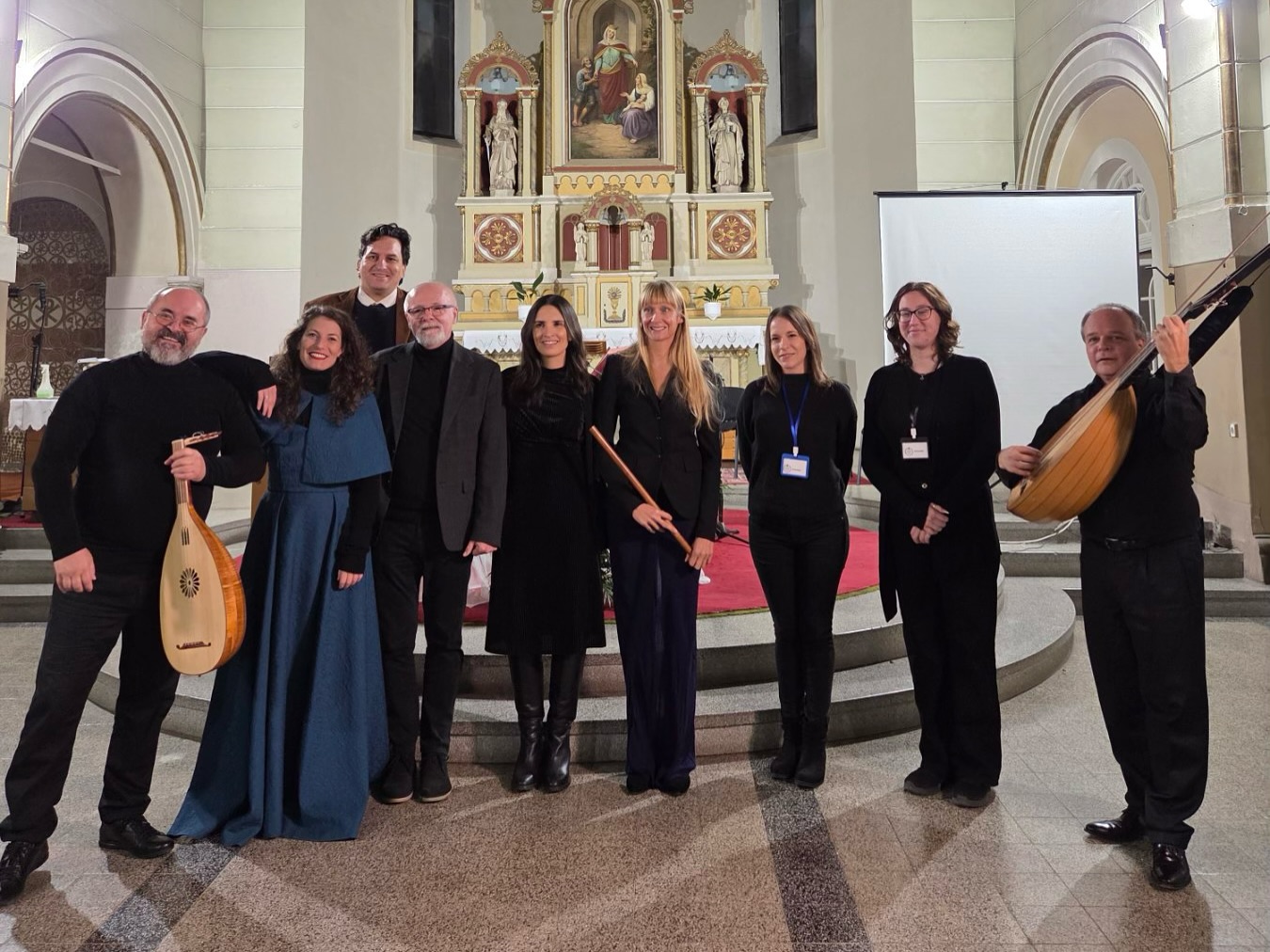
Musica Antiqua Neoplantensis (RS)
Radoslava Vorgić: soprano
Meila Tomé Pihler: recorders
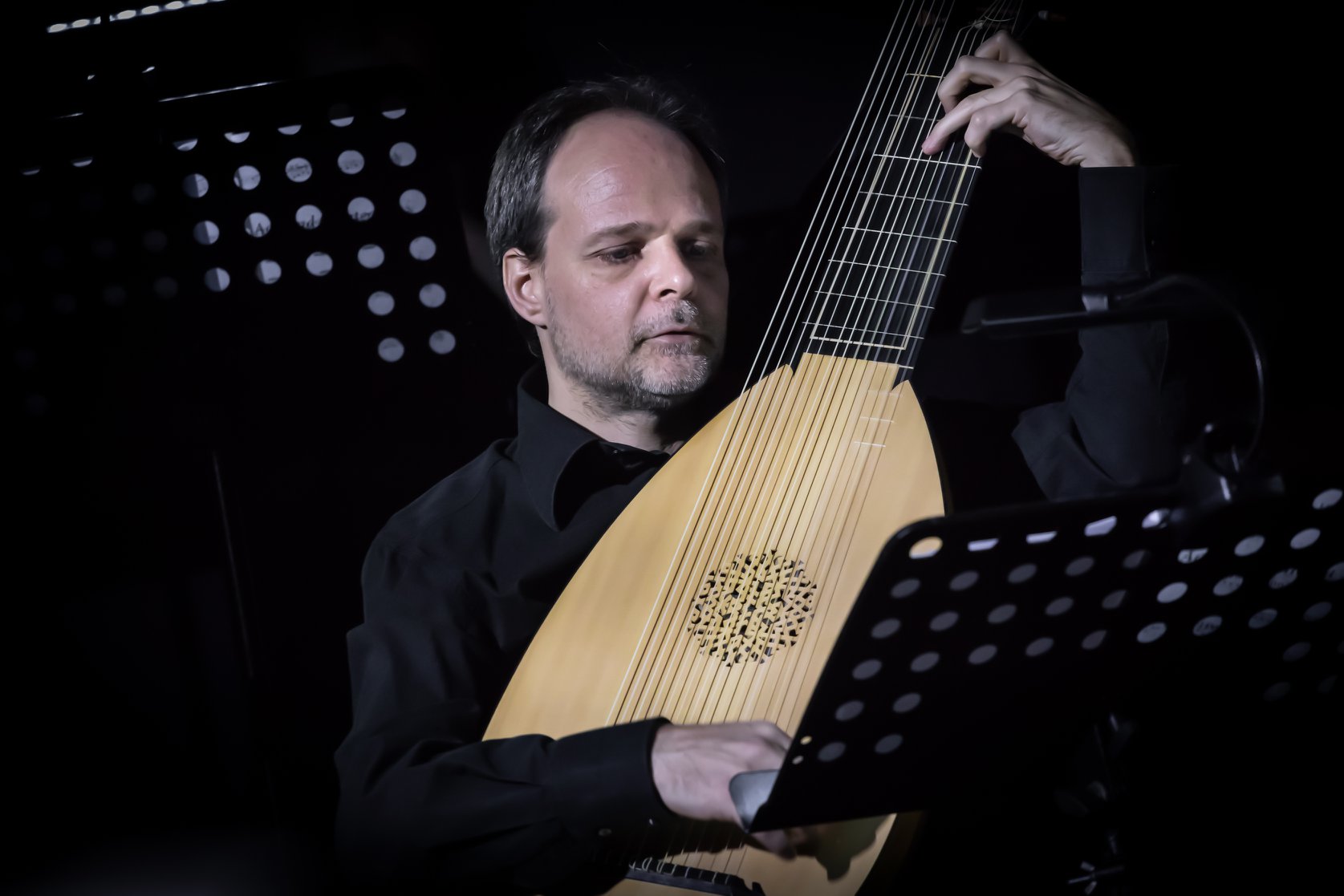
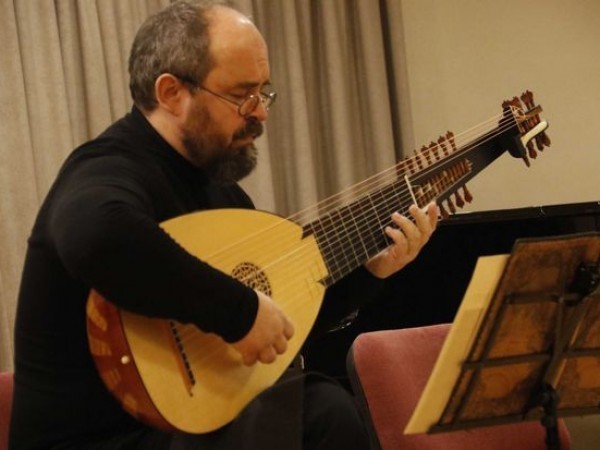
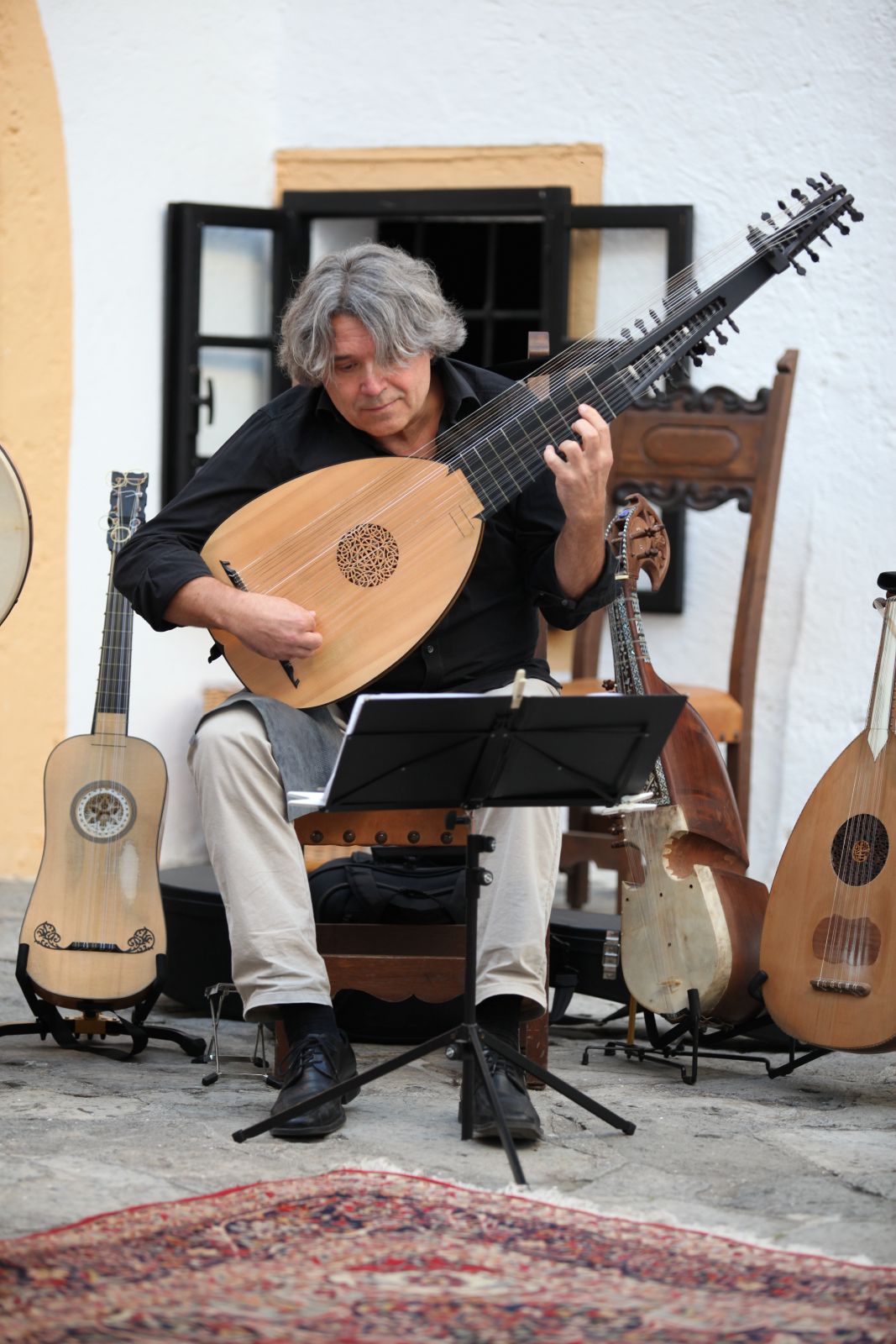
Andrej Jovanić: theorbo, archlute
Darko Karajić: theorbo, archlute
Boris Šinigoj: medieval lute, Arabic lute
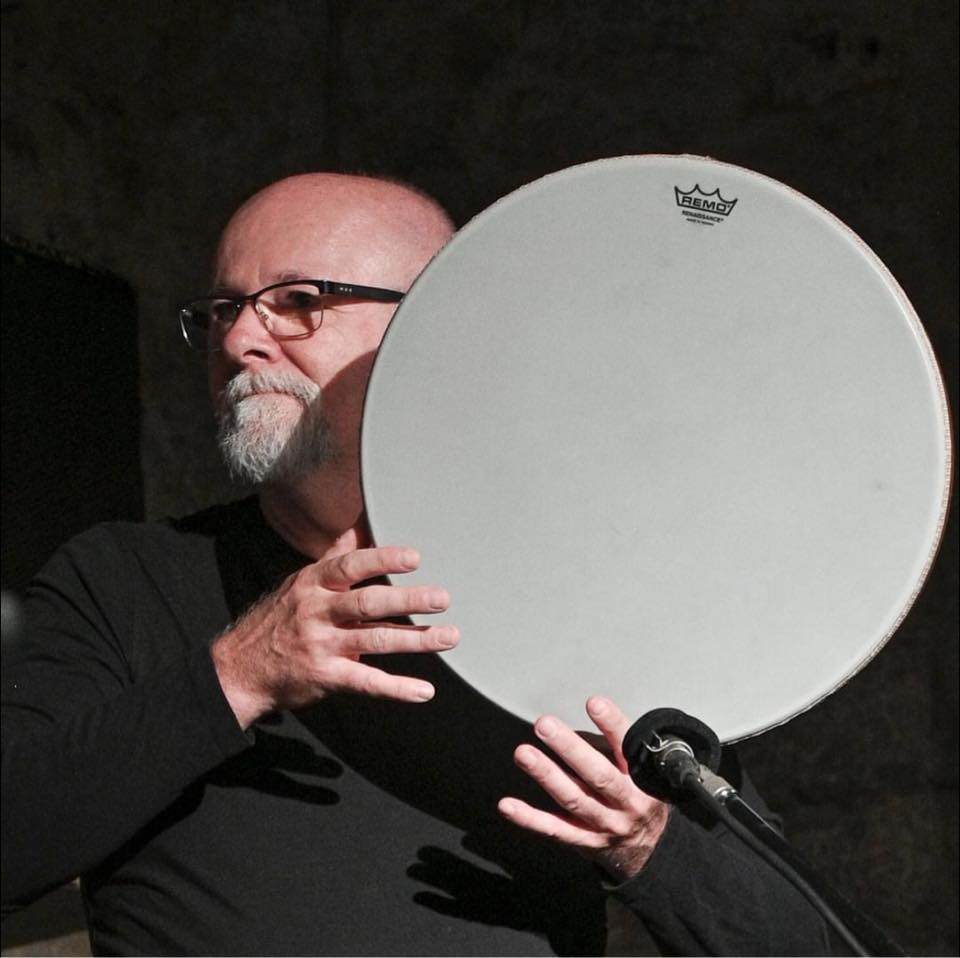
Boris Bunjac: percussion

Ticket order:
This programme presents a highly relevant and contemporary artistic approach to medieval repertoire through a renewed interpretation of the historical figure of Barbara of Celje – Queen and Empress of Hungary, Germany and Bohemia, born in Celje, and one of the most powerful and influential women of late medieval Central Europe.
Its relevance lies in a clearly defined, research-based focus on Central Europe, specifically the Hungarian, German and Bohemian cultural spheres, which remain significantly underrepresented in today’s early music performance practice compared to the dominant French and Italian repertoire. The programme brings to light rarely performed sources, including works by Petrus Wilhelmi de Grudencz, Bohemian chant traditions, and the German Minnesang, presented within a coherent and contemporary artistic framework.
The artistic concept is grounded in a dramaturgy of strength, resilience and agency, presenting Barbara not as a passive or marginal figure, but as a woman who actively navigated and shaped the political and cultural structures of her time. Rather than focusing on decline or vulnerability, the programme highlights her capacity for leadership, endurance and influence within complex systems of power.
The repertoire combines Central European sources with selected works from the manuscript Llibre Vermell de Montserrat, introducing a broader medieval spiritual dimension and connecting the programme to universal themes of devotion, mortality and collective experience.
The ensemble configuration – soprano, recorder, three lutes and percussion – supports an innovative approach to historically informed performance, particularly in the exploration of rhythm, texture and controlled improvisation within medieval stylistic frameworks.
Presented in Celje, in a venue bearing her name, the programme approaches Barbara of Celje with historical respect and artistic responsibility, acknowledging her significance as a central figure of the region’s cultural and political heritage.
Barbara of Celje (1391/92–1451)
Artists’ message to visitors: We invite you to enter a musical world shaped by strength, clarity and quiet determination, inspired by the remarkable figure of Barbara of Celje. Through this programme, we do not seek to tell a story in a linear way, but to evoke a presence — one built on resilience, intelligence and inner stability. Each composition reflects a different shade of power: sometimes subtle, sometimes radiant, yet always grounded in awareness and purpose. For us, this music is a living dialogue with what it means to stand firmly, to think clearly and to act with intention. We invite you to listen beyond the surface and experience the strength that resonates from within.
Our artistic mission: We are committed to bringing early music into a living, contemporary dialogue by revealing its capacity to speak with clarity, strength and relevance today. Our artistic mission is grounded in historically informed performance, enriched by research, yet driven by the need to connect deeply with present audiences. We seek to highlight voices and repertoires that remain underrepresented, particularly from Central European traditions, and to frame them within programmes that emphasise strength, resilience and agency. Through thoughtful dramaturgy and refined musical expression, we aim to create performances that are both intellectually engaging and emotionally immediate, where tradition is not a static form but is reimagined as a vital and transformative artistic force.
Event programme
Barbara of Celje – The Inner Kingdom
Barbara of Celje (1391/92–1451), Queen and Empress of Germany, Bohemia and Hungary, born in Celje (Barbara von Cilli, Barbora Celjská, Cillei Borbála), was not a composer; yet her life, spanning Celje, Prague, Buda and the German lands, opens a powerful symbolic space of the Central European Middle Ages. This programme creates a musical portrait of the inner world of a woman who was, at once, daughter, wife, queen, outcast and myth. The selection brings together composers and anonymous sources from Hungary, Germany and Bohemia, as well as from the wider medieval European context.
This programme presents a musical-psychological portrait of Barbara of Celje – Queen and Empress of Hungary, Germany and Bohemia, born in Celje – one of the most powerful and at the same time most controversial women of the late Middle Ages in Central Europe. Rather than offering a conventional historical narrative, the programme focuses on her inner world: the tensions between faith and politics, between body and duty, between intimacy and state power. The repertoire is based on composers and musical traditions from the Hungarian, German and Bohemian cultural spheres of the 14th and 15th centuries. Anonymous Czech songs, the refined polyphony of Petrus Wilhelmi de Grudencz, the Minnesang of Walther von der Vogelweide and Oswald von Wolkenstein, as well as the expressive worlds of Heinrich Isaac and Guillaume Dufay, create a sonic landscape spanning Prague, Vienna and the Hungarian royal court. Instrumental estampies and istampitte shape the pulse of the court – enclosed, rhythmic and tense. The final part of the programme draws on the mystical atmosphere of the codex Llibre Vermell de Montserrat, where the personal drama is not resolved in myth, but in silence, transience and a confrontation with mortality. Instead of idealisation, what remains is the bare human experience of a woman who stands at the centre of power and yet is fundamentally alone. The programme is conceived for soprano, recorder, three lutes and percussion, creating a transparent yet intense sound world in which the voice becomes the bearer of an intimate, fragile and timeless narrative. Programme concept by Radoslava Vorgić.
Anonimus:
Hospodine, pomiluj ny
Petrus Wilhelmi de Grudencz (1392-ca.1480):
Presulem ephebeatum
Anonimus:
La Septime Estampie Real
(Istampitta In Pro)
Walther von der Vogelweide (ca.1170-ca.1230):
Nu alrest lebe ich mir werde
Oswald von Wolkenstein (1376/1377-1445):
Es fügt sich
Johannes Ciconia (ca.1370-1412):
O rosa bella
Anonimus:
Saltarello I
Guillaume Dufay (1397-1474):
Ave Maris Stella
Heinrich Isaac (1397-1474):
Innsbruck, ich muss dich lassen
Anonimus:
Istampitta Tre Fontane
Hildegard von Bingen (1098-1179):
O splendissima gemma
Anonimus:
O Virgo splendens
(Llibre Vermell de Monserrat)
Instrumentalni intermezzo
(improvizacija)
Anonimus:
Los set goigs recomptarem
Anonimus:
Ad mortem festinamus
(Llibre Vermell de Monserrat)
Barbara of Celje (Barbara von Cilli, Cillei Borbála, Barbora Cellská, Barbora Celjská, nicknamed the Black Queen), countess; Queen of Hungary, Germany and Bohemia, empress (b. c. 1392, probably Celje; d. 11 July 1451, Mělník, Bohemia; buried in St Vitus Cathedral, Prague, Bohemia). Her father was Hermann II of Celje, count; her mother Anna of Schaunberg, countess. Her husband was Sigismund of Luxembourg, King of Hungary, Bohemia and Germany, emperor; her daughter Elizabeth of Luxembourg, Queen of Hungary, Bohemia and Germany; her son-in-law Albert II of Habsburg, King of Hungary, Bohemia and Germany; her grandson Ladislaus Postumus, King of Hungary and Bohemia, Duke of Austria; her first cousin Anna of Celje, Queen of Poland, wife of King Władysław II Jagiełło; her brothers Frederick II of Celje, count and Prince of the Empire, and Hermann of Celje, Bishop of Freising; her nephew Ulrich II of Celje, count and Prince of the Empire; her brother-in-law Nicholas Garai, Palatine of Hungary; and her nieces Catherine Garai, countess, wife of Count Henry IV of Gorizia, and Margaret of Celje, Duchess of Cieszyn-Głogów.
Barbara was the youngest of the six children of Count Hermann II of Celje and Countess Anna of Schaunberg (d. 1396). She was brought up at the court in Celje together with her cousin Anna, who in 1402 married the Polish king Władysław II Jagiełło. Barbara was assigned an important role in her father’s dynastic plans at an early age, when after the Battle of Nicopolis (1396) opportunities opened up for the Counts of Celje within the Kingdom of Hungary. In 1401 Hermann betrothed her to the Hungarian king Sigismund, who was twenty-four years older than she. In November 1405 they were married in Krapina, and on 6 December she was crowned Queen of Hungary at Székesfehérvár. As her morning gift (dower), her husband granted her the most extensive estates and revenues ever assigned to a Hungarian queen up to that time, which placed her among the wealthiest female rulers of late medieval Europe. In addition to the traditional estates of Hungarian queens (Óbuda, Csepel, Diósgyőr, Kecskemét), a large part of these lay in Slavonia: the towns of Gradec (the royal part of Zagreb), Koprivnica (with its castle), Virovitica (with its county), Požega (with its castle and county), and the castles/lordships of Veliki and Mali Kalnik, Garić, Garešnica, Stupčanica and Paližna. From 1407 onwards, following her husband’s example, she also maintained her own court.
Barbara and Sigismund were regarded by their contemporaries as the most beautiful ruling couple in Europe. Barbara was famed for her education, mastered several languages, and early acquired strong influence at court and over her husband’s political decisions (documents mention her consent). In 1408 she and Sigismund were also co-founders of the elite chivalric Order of the Dragon (Societas Draconistarum). In 1409 the couple’s daughter Elizabeth was born, who was at the same time Sigismund’s only child and heir to the throne (betrothed in 1411, married in 1422 to Duke Albert V of Habsburg). In governing, Sigismund relied on Barbara and repeatedly authorised her to administer the kingdom in his absence (1412–14, 1415–19, 1430–32). In this she found support especially in her brother-in-law Nicholas Garai, the leading Hungarian magnate and palatine (d. 1433, married to Anna of Celje), and in the Archbishop of Esztergom, John Kanizsai.
In 1410 Sigismund was also elected King of Germany, by which Barbara became Queen of Germany as well. The couple’s coronation took place on 8 November 1414 in Aachen (Barbara was the last German queen to be crowned in this ancient capital of Charlemagne). Sigismund arrived from Italy, while Barbara came through Nuremberg with a magnificent escort of 2,000 horsemen. After the coronation, in December they travelled together to the Council of Constance, where Barbara, through her public appearances over the following half-year, received great European publicity (as recorded in the illustrated chronicle of Ulrich von Richental). After returning to Hungary in November 1415, she again ruled for four years in the king’s name, but she is said not to have been equal to the difficult situation (Ottoman incursions, disputes among the nobility). In addition to the unproven assumptions of older historiography about infidelity, this is said to have been one of the reasons why, after Sigismund’s return in February 1419, she fell into his disfavour. She and her daughter were exiled until the end of the year to Várad (Oradea in present-day Romania), and her estates were temporarily confiscated. The true reasons for the conflict between the spouses remain insufficiently clarified.
At the end of 1419 they reconciled, and this was followed by a decade and a half of harmony. Barbara accompanied her husband on numerous political journeys and military campaigns. After the death of his brother Wenceslas in 1419, Sigismund also became heir to the Bohemian crown (at that time the Hussite movement had broken out in Bohemia). At the beginning of 1420 Barbara was with her husband in Wrocław in Silesia and then on the first of five crusades against the Hussites in Bohemia, where in July he besieged Prague and was crowned King of Bohemia (Barbara only in 1437). At the beginning of May 1422 the couple attended in Vienna the wedding of their fourteen-year-old daughter Elizabeth to Duke Albert V of Habsburg (the marriage contract between them had already been concluded in September 1421; the bride was assigned an exceptional dowry of 100,000 florins, and in the event of Albert’s and Sigismund’s deaths the guardianship of Elizabeth’s descendants was assigned to Barbara and her great-grandfather Hermann II, which demonstrates the exceptional influence of the Counts of Celje at the Hungarian court).
In the spring of 1422 Barbara accompanied her husband on the campaign against the Hussites into Moravia and in the summer to the imperial diet in Nuremberg (her second and last time in Germany), in March 1424 to the coronation of the new Polish queen Sophia (Sonka) Holszańska in Kraków, in the winter of 1426–27 on the military campaign into Transylvania, and in January 1429 to the Polish king Władysław II at the diet of the Grand Duchy of Lithuania in Lutsk (present-day Ukraine). She was present with her husband at three German imperial diets: in Wrocław in 1420, Nuremberg in 1422, and Bratislava in 1429. Her active role is also indicated by the fact that at the beginning of 1429 she was admitted together with Sigismund (as a lay person) into the Teutonic Order, which was of great importance in the king’s political plans. Barbara’s kinship ties and genuine contacts with the Polish king Władysław II in particular contributed to the long-lasting good relations between Sigismund and Poland. Mention should also be made of the diplomatically eventful summer of 1424, when the court at Buda hosted King Erik of Denmark, Sigismund’s cousin (on his way to Jerusalem), the Byzantine emperor John VIII Palaiologos, the Serbian despot Stefan Lazarević, an embassy of the Turkish sultan Murad II, Duke William III of Bavaria, and Barbara’s and Sigismund’s daughter Elizabeth with her husband Albert V of Habsburg. Barbara certainly did not play a negligible role in these events.
The harmony of the ruling couple in the 1420s was also reflected in Sigismund’s gifts to the queen. Because of the Ottoman threat, in 1424 she returned the Slavonian estates and in compensation received even richer ones in northern Hungary. The king granted her the counties of Zólyom and Trenčín with several royal towns (Zvolen, Trenčín, Brezno, Krupina in present-day Slovakia), numerous castles, and mining centres (Banská Bystrica, Kremnica, etc.). At the same time she received revenues from the thirtieth customs duty (import-export customs) throughout the kingdom. In 1426 she also received three lordships in Moravia, in 1427 the substantial Hungarian state revenues from metal extraction and the mints, in 1430 the county of Liptov, and in 1436 the Jewish tax throughout the whole empire. At the king’s death (1437) she possessed thirty major Hungarian lordships with castles and numerous towns and market towns. She became the richest woman in the kingdom and one of the wealthiest in contemporary Europe, which guaranteed her both political influence and independence. She actively and successfully managed her own economic and financial resources and was among Sigismund’s principal creditors. When in March 1436 her husband assigned to her the Jewish tax, Barbara, through her agents, actually levied it throughout the whole empire, including the Papal States. For this purpose in 1436–37 she addressed personal letters to Pope Eugenius IV and numerous princes: Duke Amadeus VIII of Savoy, Duke Filippo Maria Visconti of Milan, Duke Adolf of Jülich and Berg, Duke René of Lorraine and Bar, Duke Adolf of Cleves, and others.
Sigismund was again absent from 1430 to 1434. He was travelling in Germany; in May 1433 he was crowned emperor in Rome, and afterwards he also attended the Council of Basel (from October 1433 to May 1434). Barbara was never crowned empress, although sources often addressed her as such. She was the only medieval German ruler’s consort who did not accompany her husband to the imperial coronation. For the period of his absence Sigismund appointed her, together with her father Hermann, her son-in-law Nicholas Garai, and the Bishop of Pécs, as administrator of Hungary. The Hussite wars were at their height, and in 1431–33 the western and northern parts of Hungary were severely devastated by their campaigns (Bratislava, the most important royal centre after Buda, was also threatened). Barbara actively, though less successfully, participated in the defence of the kingdom (the largest number of her charters survive from 1432 – twenty-five). At the beginning of 1433 she also assembled an army for Sigismund’s continuation of the war against Venice (according to Hungarian envoys in Italy, 30,000 men). She was probably unable to cope with the difficult situation, and so Sigismund appointed a new regency council without the participation of the Counts of Celje. Even so, there was no break with them, as is shown by the greatest success of the dynastic policy of Count Hermann II: as early as September 1435 in Bratislava, Sigismund issued the charter elevating the Counts of Celje to Princes of the Empire, although Hermann died immediately afterwards (the ceremonial elevation took place a year later, on 30 November 1436 in Prague).
The following years were marked by events in Bohemia, where the Hussite movement was calming down. After long peace negotiations, final reconciliation was achieved in July 1436 at Jihlava, and Sigismund was able to rule Bohemia. Together with Barbara he made a ceremonial entry into Prague on 23 August, where on 11 February 1437, in St Vitus Cathedral and with the consent of the Bohemian estates, she was crowned Queen of Bohemia. The day before the coronation Sigismund also granted her extensive estates in Bohemia (the castle of Mělník later became her principal residence). During the year and a half spent in Bohemia she established close contacts with some of the leading nobles of both the Catholic and the moderate Hussite (Utraquist) parties, who later became her political allies. She learned Czech and conducted correspondence with them in Czech. Her chancellor Václav (from 1432 onwards) was also a Czech, while her personal physician Konrad was a Czech German. In July–August 1437, during Sigismund’s absence, she herself governed the Kingdom of Bohemia, which, given the delicate situation of the recently pacified land, demonstrates the great trust and cooperation between the spouses. After Sigismund’s return, now mortally ill, relations in the autumn began to deteriorate. Barbara did not support Sigismund’s choice of his son-in-law Albert V of Habsburg as successor to the Hungarian and Bohemian thrones; she favoured the Polish option of King Władysław III Jagiellon, which would have preserved for her greater political influence. During the return journey of the ruling couple from Prague to Hungary – Ulrich of Celje was also with them – Sigismund died on 9 December 1437 at Znojmo in Moravia. Albert had Barbara arrested and imprisoned in Bratislava until further notice, which meant the collapse of her political plans.
Albert was elected king by the Hungarian estates as early as 18 December 1437, and crowned on 1 January 1438. In Bohemia tensions arose between the Catholic nobility, who supported Albert (Ulrich of Rosenberg), and Barbara’s supporters, especially from the ranks of the Utraquists (Hynek Ptáček of Pirkstein, Aleš Holický of Šternberk). In April 1438 Barbara reached an agreement with Albert and was released, which pacified most of the Bohemian nobility, and Albert was on 29 June 1438 also crowned King of Bohemia in Prague. Nevertheless, civil war broke out in Bohemia. Uncertain of the future, in the summer of 1438 Barbara fled from Hungary to the Polish court in Kraków with five hundred horsemen and her treasury in the face of attacks by Albert’s supporters. She remained in exile until 1441, and all her estates in Hungary were confiscated (2 June 1438). The question of the dowager queen’s status led to Albert’s war with Poland, which from the summer of 1438 until the following spring was fought in Bohemia, in the border regions of Hungary, and in Silesia (Ulrich of Celje established good relations with Albert; he was his deputy in Bohemia and commander of the Bohemian forces in Silesia). The final reconciliation of the two sides brought Barbara no improvement in her position. Albert died of dysentery on 27 October 1439 while on campaign against the Ottomans, and Barbara’s daughter Elizabeth gave birth on 22 February 1440 to Ladislaus, heir to the Hungarian and Bohemian thrones. Ulrich of Celje became the chief protector of the rights of Elizabeth and Ladislaus to the throne. On 15 May 1440 Ladislaus was crowned King of Hungary, which divided the Hungarian nobility and led to civil war. His opponents crowned Władysław III of Poland king on 17 June; by 1442 he managed to prevail, and until his premature death in 1444 (Battle of Varna) he established himself in Hungary as the legitimate ruler. Only in 1445 was the five-year-old Ladislaus Postumus recognised as the new King of Hungary.
In Bohemia, after 1439, an uncertain period of interregnum began (Ladislaus Postumus was recognised as King of Bohemia only in 1453). Nevertheless, with the support of a loyal part of the Bohemian nobility, Barbara was able to return in July 1441 and settled at Mělník as the dower seat of the queens of Bohemia. She entirely abandoned political ambitions in Hungary after the birth of her grandson Ladislaus and was also reconciled with her daughter Elizabeth (who died as early as 19 December 1442). In Bohemia, with her influential supporters (Ptáček, Holický, Poděbrady), she for some time retained a certain influence, though withdrawn from public life. This is attested also by her mission in the summer of 1448 to the papal legate Carvajal, who was then in Bohemia. From 1445 onwards her principal supporter and administrator of her estates was George of Poděbrady (later the leading Bohemian statesman, from 1453 protector of King Ladislaus Postumus, and from 1458 to 1471 King of Bohemia). Her secluded life at Mělník stirred the imagination and became the source of later, mostly unfounded rumours of a godless life, orgies, and alchemy. She died of plague on 11 July 1451; she was buried – accompanied also by Hussite priests – in the royal tomb in St Vitus Cathedral in Prague (the location of the grave, once marked by a striking tombstone, is no longer known).
Barbara was undoubtedly an extraordinary example of a late medieval female ruler. She is described as intelligent, educated, ambitious, capable, influential, beautiful, and lively, which aroused strong opposition among her political enemies. It was precisely negative political propaganda that tarnished her memory right up to the twentieth century, including in historiography, where she was considered a “German Messalina”. Only in recent decades has she undergone historical rehabilitation. From the period of her life there is no evidence to justify these accusations. Negative propaganda – concerning the entire House of Celje – originated above all from the circle of the Habsburgs, their principal rivals for political influence in the Central European sphere. Particularly influential in this was the humanist Aeneas Silvius Piccolomini, from 1443 secretary and diplomat to King/Emperor Frederick III, whose biased view drew especially on Kaspar Schlick (d. 1449), the emperor’s chancellor and one of Barbara’s great enemies. Piccolomini wrote about the queen in several of his works (De viris illustribus; Historia Austrialis; Historia Bohemica), which strongly influenced the establishment of her image, particularly after the author’s rise to the papacy (Pius II, 1458–64). Already in the fifteenth century he was echoed by the Polish historian Jan Długosz, Antonio Bonfini, active at the Hungarian court (historian of King Matthias Corvinus), and Hartmann Schedel of Nuremberg. At the beginning of the sixteenth century all Piccolomini’s claims were adopted and further amplified – especially those concerning her sexual desire – by Johannes Cuspinianus, who served at the court of Emperor Maximilian; after him, in the seventeenth century, Johann Jakob Fugger called her a “German Messalina”. The negative image of Barbara and her house was later disseminated also by national historiography in those lands in which they appeared as political opponents of domestic dynasties (Austria, Hungary, Croatia).
Barbara was an exceptionally educated woman of her time. Besides German she knew Latin, Hungarian, Czech, presumably Polish, and – given her native environment – probably Slovenian. Despite the accidental and partial survival of her correspondence, it shows contacts with many influential persons of the age: the Polish king Władysław II and Queen Sophia, the Grand Duke of Lithuania Vytautas, the Bohemian magnate Ulrich of Rosenberg (in Czech), the Grand Master of the Teutonic Order Paul von Rusdorf, the imperial chamberlain Konrad von Weinsberg, the mayor of Vienna Hans Holczler, and others. She was also repeatedly in contact with several important cities of the German Empire – Frankfurt, Lübeck, Vienna. Her active participation in government and public life is attested by at least 270 of her surviving charters (from the Hungarian National Archives in Budapest alone), which far exceeds other late medieval queens. She was unquestionably the most politically active female ruler of that period in Europe, as is also shown by her itinerary – in the course of her rule in Hungary she undertook no fewer than 114 journeys between 1405 and 1438 (though she spent most of her time in Buda, where most of her charters were issued). The discovery of new sources that might shed light on her many-sidedness cannot be ruled out, as is suggested by a recent remarkable finding: in 1429 the queen founded the noble/ladies’ chivalric Order of the Phoenix, thereby showing extraordinary originality and self-confidence; nothing comparable existed in Europe at that time.
Accusations of Barbara’s impiety spread only after her death. Perhaps also because she spent the end of her life among the Hussites, who for many still counted as heretics. In the sixteenth century she even ended up on a list of the greatest heretics “since the beginning of the world” (Gabriel du Préau, 1569), although she was deeply devout and regularly attended church services (in 1424, for example, she received from Pope Martin V the privilege of a personal portable altar, an early Mass before the beginning of the day, and the free choice of confessor). Like other members of the House of Celje, she distinguished herself by supporting ecclesiastical institutions; in this she did not differ from her contemporaries. This is testified by a series of her privileges for monasteries, especially for the Pauline monks in Slavonia (the Pauline monastery of Lepoglava in Zagorje, around 1400, was the first of the monastic foundations of her father Hermann II). After her death, in 1452, the general chapter of the strict Carthusian order decided that prayers for her were to be offered in all the houses of the order throughout Europe, which testifies to her piety and favour towards the Carthusians (a family tradition of the Counts of Celje). Against the accusations mentioned would also speak the fact that reformist Hussite priests accompanied her funeral. There is, however, probably a grain of truth in her interest in alchemy, about which her contemporary, the Bohemian alchemist Johann von Laaz, wrote, claiming that he visited her in her workshop (supposedly at Mělník).
After her departure from Celje in 1405, according to present knowledge Barbara never again visited the Slovene lands or had noteworthy contacts with them. The exception is a charter issued on 25 January 1417 at Veszprém, by which she confirmed that her brother Frederick, for 4,000 florins lent to him, had pledged to her the castle of Mehovo below the Gorjanci Hills (the charter preserves her seal with the Hungarian and Celje coats of arms and the inscription: S.BARBARE.DEI.GRATIA.REGINE.VNGARIE). How long she possessed Mehovo is unknown; later the castle was again in the possession of the Counts of Celje. Between 1408 and 1412 she stayed several times on her father’s and her own estates in Slavonia, in the immediate vicinity of her native lands. In January 1408 she was in Čakovec, in September in Samobor, and in October–November 1412 in Koprivnica, at Veliki Kalnik Castle, and in Križevci. It cannot be ruled out that she may also have visited Celje (she was an exceptionally mobile ruler). Certain indirect evidence of the preservation of some contacts is provided by some of her castellans in Slavonia, who came from the clientele of her father Hermann. The influential Sigismund Neuhauser (from Dobrna) was her castellan at Kalnik; he was even admitted into Sigismund’s Order of the Dragon and was buried at Ptujska Gora, which the Counts of Celje also generously endowed with works of art. The Styrian knight Gašper Rattenperger is attested in 1414 as her castellan at Stari grad/Kamengrad (Kewar) near Koprivnica.
Despite Barbara’s active public life, not a single true portrait of her has survived or is known. Together with Sigismund she is depicted in several illustrated versions of Ulrich von Richental’s chronicle of the Council of Constance in scenes of public manifestations (the ceremonial arrival of the royal procession into the town, Christmas Mass, the Easter Sunday procession, etc.). In the opinion of art historians, perhaps the closest thing to a portrait is the church fresco by Master Wenceslas at Riffian in South Tyrol, where the king and queen are shown in the motif of the fall of the golden calf. It was created in 1415, perhaps under the direct influence of Barbara’s appearance at Constance. Similar is the figure of Saint Barbara on the winged altar from the Finnish village of Kalanti, created after 1420 (its master was a Dominican from Hamburg). Besides the recognisable Sigismund, the figure of the saint is depicted, probably a cryptoportrait of Barbara. Her most famous depiction, however, is as Venus on horseback in Konrad Kyeser’s Bellifortis (c. 1414–15). The negative propaganda of fifteenth- and sixteenth-century historiography and the improbable accusations found an echo also in numerous tales and legends of the “Black Queen”, recorded in Croatia, Hungary, and Slovakia. Barbara’s figure acquired its strangest role as an alleged literary model for the vampire Carmilla, Dracula’s female double, in the novella by the Irish writer Joseph Sheridan Le Fanu (1872); the story is set in Styria, in the fictional lordship of “Karnstein”.
Miha Kosi
We gratefully acknowledge the Novo Slovenski biografski leksikon for granting permission to publish (https://www.slovenska-biografija.si/oseba/sbi1023710/).
Petrus Wilhelmi de Grudencz (b. 1392 – after 1452) is regarded as one of the most significant representatives of Central European music in the fifteenth century. His output, comprising around forty surviving works, reveals a distinctive musical language rooted in the cultural landscape of Poland, Bohemia, Germany and Austria.
Educated at the University of Kraków and active within the circle of Emperor Frederick III, Petrus worked in an environment where humanist scholarship, ecclesiastical practice and musical creativity intersected. His compositions circulated widely in Central European manuscripts, particularly in Bohemia, where they remained popular long after his death.
A defining feature of his work is the close interplay between poetic and musical expression: he frequently embedded acrostics of his own name within the texts, reflecting an emerging Renaissance awareness of authorship. His oeuvre includes Latin songs (cantiones), polytextual motets and canonic forms (rotula), in which he combines older medieval techniques such as isorhythm and hocket with more recent harmonic developments.
Although familiar with the achievements of Franco-Flemish polyphony, Petrus deliberately draws on local Central European traditions. His music was primarily intended for educated, though not necessarily professional, performers—university circles and ecclesiastical confraternities—which is reflected in its clear structure, rhetorical character and often playful treatment of text.
Today, Petrus Wilhelmi increasingly emerges as a composer who does not belong to a single national tradition, but rather represents the shared cultural space of Central Europe. His music thus offers a valuable insight into the diverse and dynamic artistic landscape of the fifteenth century.
Walther von der Vogelweide (c. 1170–c. 1230) is regarded as the most important lyric poet of the German Middle Ages and one of the central poetic figures of medieval European literature. He composed in Middle High German and wrote love songs, political verse, and religious poetry. His œuvre ranks among the most extensive and influential in medieval German literature.
Relatively little is known about his life. Outside the literary tradition, he is documented only once, in 1203, in a record of travel expenses of the Bishop of Passau, Wolfger von Erla. Most of what we know about him must therefore be inferred from his own works and from references by contemporary authors, among whom he is mentioned with great respect by Wolfram von Eschenbach and Gottfried von Straßburg.
Walther was active at various courts and was connected with some of the most important political figures of his time, including Philip of Swabia, Otto IV, and Frederick II. In his political poetry, he responded to key issues of his era, particularly the tensions between Empire and Papacy, often taking a clear and outspoken stance. One of the central themes of his work is the question of just rulership and the relationship between secular and ecclesiastical authority.
Equally significant is his contribution to love lyric. Walther enriched the tradition of Minnesang with a new conception of love: alongside the idealised and unfulfilled “high love”, he developed a more reciprocal, human, and fulfilled understanding of the relationship between lovers. Among his most famous poems is Under der linden, which, with its immediacy and freshness, remains one of the best-known works of medieval lyric poetry.
Walther’s place of birth is not known with certainty, nor is the location of his grave, although tradition associates it with Würzburg. Despite these unresolved biographical questions, his work remains remarkably vital: through its linguistic power, artistic refinement, and strong personal voice, Walther von der Vogelweide continues to be recognised as one of the most original and influential poetic voices of medieval Europe.
Oswald von Wolkenstein (c. 1376/77–1445) was a poet, composer and diplomat, and one of the most distinctive figures of the late Middle Ages. His life was remarkably eventful: as a young man, he left his home and spent years travelling across Europe and beyond – as far as the Mediterranean and the Near East. These experiences later found expression in his autobiographical songs, which rank among the most original voices of medieval European lyric.
He lived in a politically turbulent period and was closely connected with the court of Emperor Sigismund, husband of Barbara of Celje, for whom he undertook diplomatic missions across Europe. He also took part in major historical events, including the Council of Constance, where political, religious and cultural dynamics intertwined – dynamics that also shaped Barbara’s position and influence within the European sphere.
Oswald’s life was marked by personal disputes, conflicts over inheritance, and complex relationships with the regional nobility. Despite this, he created an extensive and highly diverse body of work that combines elements of courtly lyric, personal expression, and political commentary. His songs often intertwine themes of travel, faith, love and physicality, distinguished by their immediacy, strong individuality, and at times striking boldness.
As a composer, Oswald is one of the most important figures of the late medieval German-speaking world. A particular feature of his legacy is that two collections of his songs were compiled under his own supervision, a rare circumstance for the period. The surviving manuscripts thus represent not only a major musical and literary source, but also one of the earliest authentic representations of a medieval author.
Within a programme centred on Barbara of Celje, Oswald’s work offers a direct insight into the cultural and political world she inhabited – a world of dynastic connections, diplomatic journeys, and the interplay between personal experience and broader historical processes.
Johannes Ciconia (c. 1370 – 1412) stands as a key figure in the transition from the late Middle Ages to the early Renaissance. Born in Liège, he spent most of his creative life in Italy, particularly in Rome and Padua, where he worked within both ecclesiastical and humanist circles.
His music displays remarkable stylistic diversity, combining elements of the French ars nova, the complexity of ars subtilior, and the traditions of the Italian trecento, while already pointing towards emerging Renaissance aesthetics. His output includes sacred works (motets and Mass movements) as well as secular compositions in both French and Italian forms, often connected to specific historical events or patrons.
Ciconia also occupies an important place as a music theorist. In his treatises Nova Musica and De proportionibus, he explores new approaches to intervallic and harmonic relationships, seeking to relate music to the rhetorical principles of humanism. His thinking reflects an awareness of music as an expressive language comparable to speech—an idea that would become fundamental in later European musical thought.
He is among the first composers of northern origin to realise a major artistic career in Italy, thereby contributing significantly to the formation of an international musical style. His works bring together diverse European traditions into a coherent artistic language and influenced later composers, including Guillaume Du Fay.
Today, Ciconia is recognised not merely as a synthesiser of existing styles, but as a composer who reshaped and connected them in an original way. His music offers a vivid insight into a dynamic historical moment in which medieval heritage gradually transforms into Renaissance artistic thought.
Guillaume Dufay (1397–1474) is regarded as one of the most important composers of the early Renaissance and the leading musical figure of his time. His work stands at the transition from the Middle Ages to the Renaissance, combining diverse European stylistic influences into a distinctive and refined musical language.
He was educated at Cambrai Cathedral and subsequently worked across major European centres, including Italy, France and the papal court in Rome. Closely connected with the most important political and ecclesiastical institutions of his time, his music was widely disseminated and performed throughout Europe.
Dufay’s œuvre encompasses nearly all major genres of his time: masses, motets and other sacred forms, as well as secular songs. His music integrates complex late medieval techniques with newer, more melodic and harmonically balanced approaches characteristic of the early Renaissance. He played a crucial role in the development of the cyclic mass and in shaping a new sound ideal of European polyphony.
As a distinctly cosmopolitan artist, Dufay brought together different regional traditions and influences, contributing significantly to the formation of a shared European musical culture. His work marks a shift towards the understanding of the composer as an independent artistic figure, one of the key developments in music history.
Within a programme engaging with the world of Barbara of Celje, Dufay’s music reflects the same European sphere: a network of courts, ecclesiastical centres and political connections in which the cultural currents of the late Middle Ages and early Renaissance were formed.
Heinrich Isaac (c. 1450–1517) was one of the most important composers of the late Renaissance and a central figure of the Franco-Flemish musical tradition. His work encompasses a wide range of genres: masses, motets, secular songs in French, German and Italian, as well as instrumental music.
Relatively little is known about his early life, though he likely originated from the region of Brabant. His career spanned more than three decades and took him across major European centres, including Italy, Austria and the German-speaking lands. He served at the court of Emperor Maximilian I and in Florence within the circle of the Medici family, one of the most significant cultural environments of the time.
Isaac was an exceptionally prolific and versatile composer. His music combines the rich polyphonic tradition of the North with Italian melodic sensitivity. Among his best-known works is the song Innsbruck, ich muss dich lassen, while one of his most ambitious projects is the monumental Choralis Constantinus, an extensive cycle of motets for the Mass Proper throughout the liturgical year.
His influence was particularly strong in the German-speaking regions, where he played a key role in establishing the Franco-Flemish polyphonic style. As a distinctly cosmopolitan artist, Isaac connected diverse musical traditions and worked within a broader European cultural space shaped by the political and dynastic networks of the late Middle Ages and early Renaissance.
Hildegard of Bingen (1098–1179) was a Benedictine abbess, mystic, writer, composer, and one of the most remarkable female figures of the Middle Ages. Her work encompasses theology, visionary literature, music, natural history, medicine, and reflections on humanity, the cosmos, and ethics.
Dedicated to the Church in childhood, she later lived first at Disibodenberg and then became the founder of the monastery of Rupertsberg near Bingen, as well as a daughter house at Eibingen. Her public activity was extraordinary for her time: as a nun, she preached publicly, corresponded with influential ecclesiastical and secular figures, and emerged as a spiritual adviser and moral authority.
At the centre of her œuvre stand three major visionary-theological works – Scivias, Liber vitae meritorum, and Liber divinorum operum – in which she brings together the image of the world, the human being, and God into a vast symbolic and theological whole. Alongside them survives an extensive body of letters, revealing her forceful personality, intellectual independence, and considerable influence within the spiritual and political world of the twelfth century.
Her music also occupies a distinctive place. The collection Symphonia harmoniae caelestium revelationum and the musical-liturgical drama Ordo virtutum rank among the most original musical creations of the medieval period. Hildegard’s musical language is marked by wide melodic range, strong symbolism, and a close connection to her visionary thought.
She is also associated with important writings on natural history and healing, especially Physica and Causae et curae, which reflect the medieval interrelation of nature, body, soul, and cosmic order. In modern times, her reception has been extraordinary; in 2012 Pope Benedict XVI declared her a Doctor of the Church. Hildegard of Bingen thus remains one of the central figures in the spiritual, intellectual, and musical history of Europe.
Celje, Princely Palace