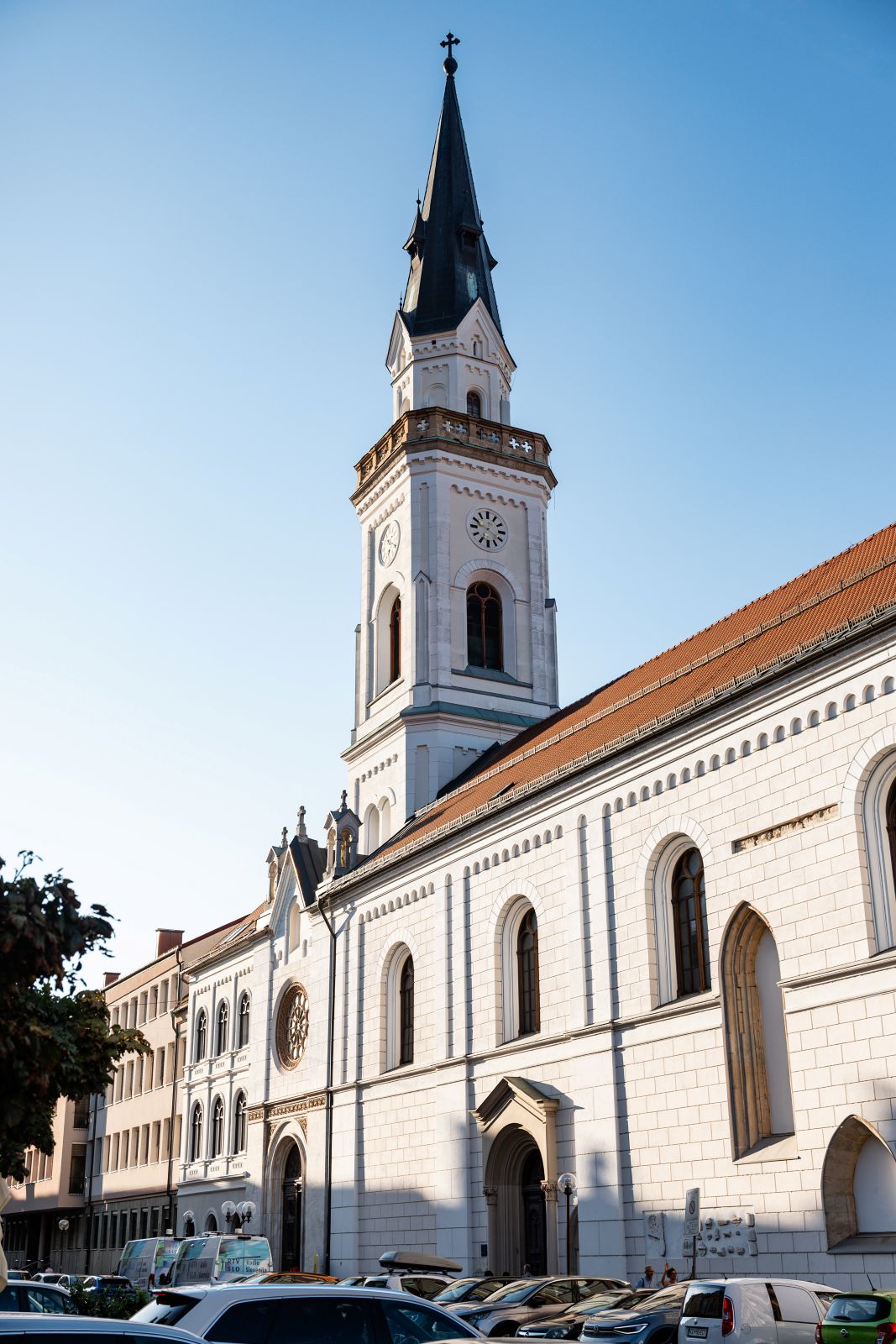
Celje, Church of the Assumption of the Virgin Mary
Church of St Mary, Minorite Church, filial church
The Church of the Assumption of Mary in Celje today almost disappears among the surrounding buildings on Prešeren Square, yet it holds within it the powerful history of our ancestors.
The original church was consecrated as early as 1310, with the permission of the Patriarch of Aquileia, and stood independently on this site, as it does today. When the Minorites arrived in Celje, they built a monastery next to the church (part of today’s prison – Stari pisker). From that time on, it became known as the Minorite Church. The famous Counts of Celje also had their tomb there. By imperial decree in 1808, the Minorite monastery was abolished, and it was ordered that the church be demolished as well. Indeed, the presbytery and the towers soon began to be taken down. Blessed Anton Martin Slomšek, then a student at the Celje grammar school, wrote in his diary: “What times these are, when even churches are being demolished!” However, the German-speaking part of the town’s population petitioned Vienna to preserve the church for their needs, and so – thanks be to God – the main body of the church remained. From then on, it was known as the German Church.
The church was more thoroughly restored in the 19th century according to the plans of the architect Bucher, with the works completed in 1880. At that time, the present bell tower was also added. Thus, although the Church of St Mary is fundamentally Gothic in origin, today it presents a distinctly Baroque appearance with a Neo-Romanesque bell tower.
In 1979, a powerful gas explosion occurred in a building constructed on the site of the former presbytery (where the present NKBM building stands), nearly destroying it. The presbytery, with its magnificent fresco of the Assumption of Mary, was so badly damaged that it had to be completely rebuilt, and the fresco restored. This major work was carried out excellently by the academic painter Viktor Povše.
As the church was in very poor condition, a comprehensive restoration became necessary. Between 2006 and 2008, the entire exterior of the church was renovated. Restoration work has also begun in the interior, with almost all the altars and the pulpit already restored.